
GUIDE. SUBSEA
The Eastern Mediterranean as a gateway.
Three continents meet in the Eastern Mediterranean. For data, that makes it a natural crossing point between Europe, the Gulf and Asia. This guide explains why new routes are being built there.
By the UNIFI network team. 5 minute read.
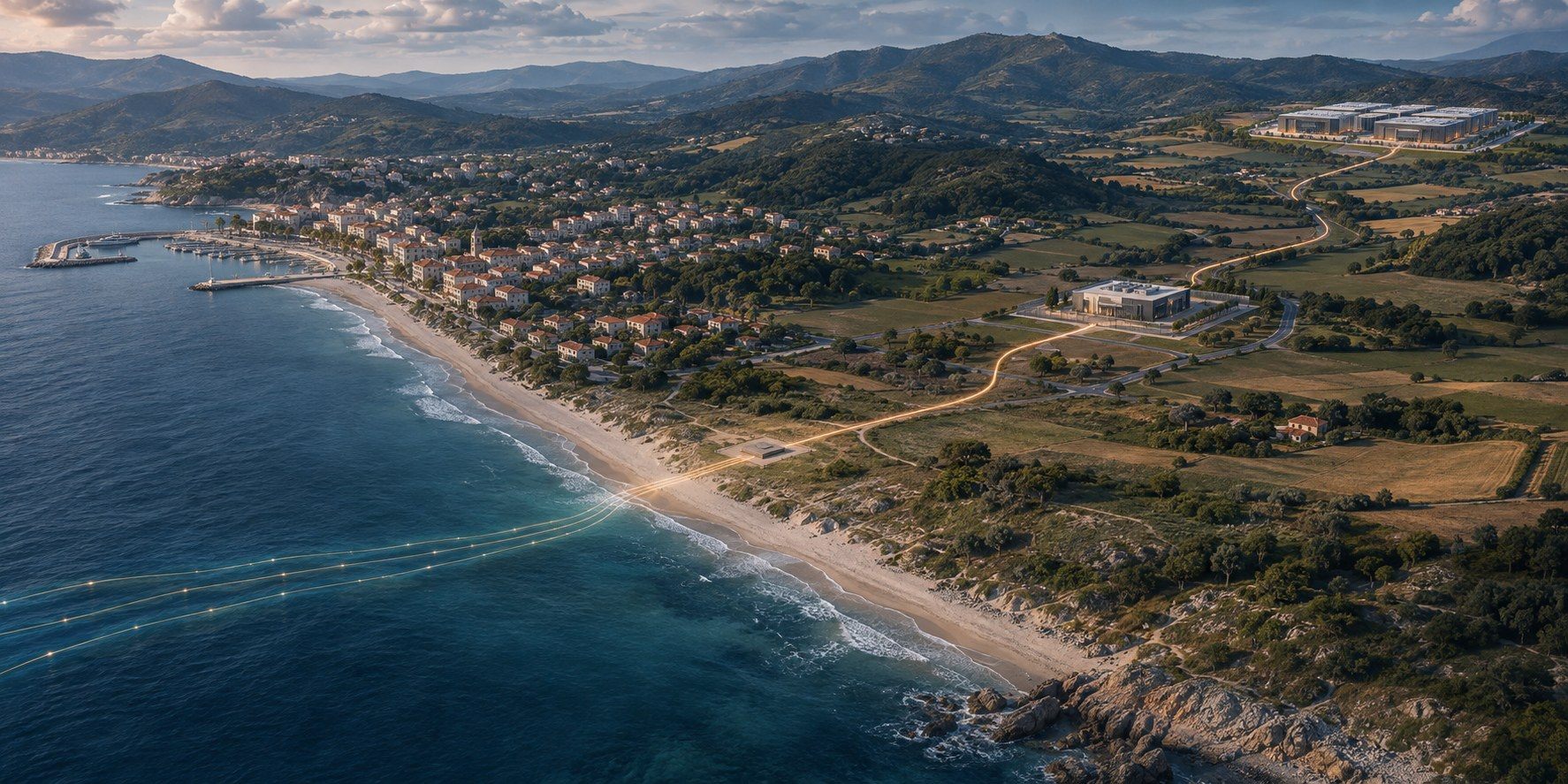
THE SHORT ANSWER
The region offers a second way between Europe and the Gulf, by sea and by land.
- 3 continents
- Europe, Asia and Africa meet here
- 240 km
- from Cyprus to the Levant coast on Ebla (UGARIT 2)
- Sea and land
- Short sea crossings joined to land routes toward the Gulf
Why geography matters again
For years the region was a place cables passed by. Most traffic between Europe and Asia went through Egypt and the Red Sea.
Two things changed. That single path proved fragile. And the Gulf began building some of the largest Ai campuses in the world, which need more than one way to reach Europe.
The three pieces
- Cyprus. A member of the European Union with established landing stations and onward links to mainland Europe.
- The Levant coast. A short sea crossing from Cyprus, and the western end of land routes toward the Gulf.
- The land route. Fibre across the Levant toward the Gulf, which avoids the narrow passages at sea.
What is being built
New cables and renewed ones. Short modern systems are being laid beside links from the 1990s, and those older cables are being renewed to carry far more.
Together they turn a quiet corner of the map into a working gateway.
SIDE BY SIDE
The classic route and the Eastern Mediterranean route compared.
| Through Egypt and the Red Sea | Through the Eastern Mediterranean | |
|---|---|---|
| Path | Long sea route with one land crossing | Short sea crossing joined to land routes |
| Chokepoints | Suez and the Red Sea | Avoids both |
| Maturity | Established, with many systems | New, with systems now in delivery |
| Best use | The bulk of today’s traffic | A protected second path |
| Who benefits | Existing carriers | Gulf compute, the Levant and Europe |
IN PRACTICE
We have built, renewed and managed cables in this sea.
UNIFI is building Ebla (UGARIT 2), a 240 km system with 24 fibre pairs, as prime contractor and part owner alongside Cyta and Syrian Telecom. Service is targeted for mid 2028, subject to project conditions.
Before that we renewed UGARIT 1 between the same two landings, taking it from 622 Mbps to 6 Tbps. Across the sea, we own IG 1 between Italy and Greece.
BEFORE YOU DECIDE
Five questions if you plan to use this gateway.
- Which landing gives you the best onward link into Europe?
- How will your traffic travel on land beyond the coast?
- Which national operators must be partners?
- What licences and approvals apply, and who holds them?
- When will the new systems be ready for service?
The fourth question decides the timetable. It is where experience counts most.
COMMON QUESTIONS
Short answers.
Why is the Eastern Mediterranean important for data?
It lies between Europe, the Gulf and Asia, and offers a path that avoids Suez and the Red Sea.
Which country is the main hub?
Cyprus is the European Union landing point, with links onward to mainland Europe.
Is the land route to the Gulf open today?
Sections are being built. It is a route in development, to be confirmed project by project.
Who is building in the region?
National operators with international partners. UNIFI is one of them.
Looking east from Europe, or west from the Gulf? Talk to us.